
If you manage a warehouse, distribution center, or logistics park in Dubai, you already know the dust never really stops. Between truck traffic, pallet debris, sand blowing in from open yards, and constant loading-dock activity, floors get dirty fast — and dirty floors slow everything down. This is where a ride-on industrial sweeper earns its place on the equipment list.
In this guide, we’ll break down what a ride-on sweeper actually is, how it’s different from smaller walk-behind machines, and — most importantly — how to know when your facility has genuinely outgrown manual cleaning and needs to make the switch.
What Is a Ride-On Industrial Sweeper?
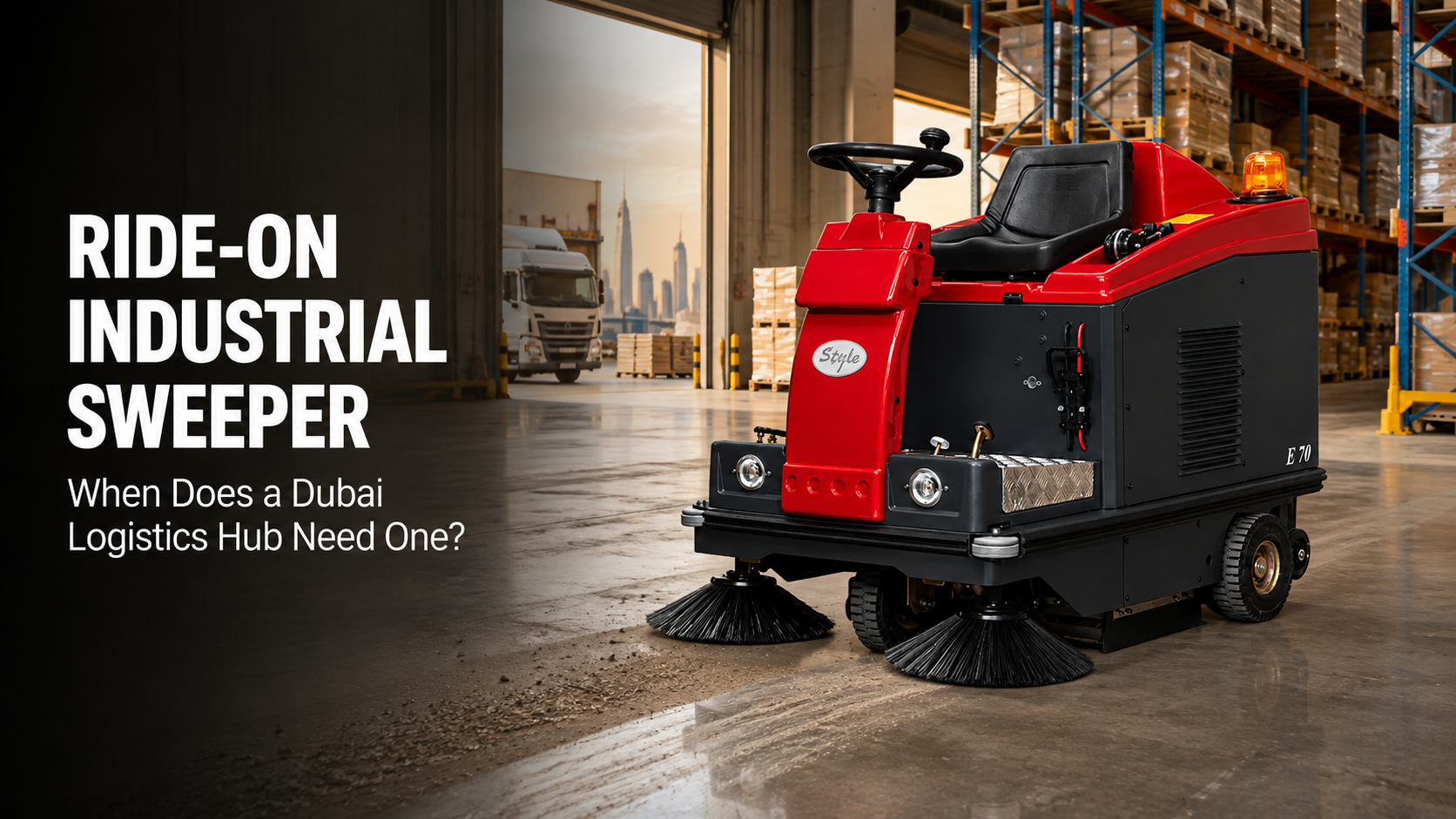
A ride-on industrial sweeper is a self-propelled cleaning machine that an operator drives, much like a small utility vehicle, to sweep large floor areas quickly and consistently. Unlike a broom, a shop vacuum, or even a walk-behind sweeper, a ride-on unit is built for scale — covering thousands of square meters per hour rather than per shift.
Most ride-on sweepers combine:
- Rotating side brooms that pull debris from corners and edges into the machine’s path
- A main brush or roller that lifts dirt, dust, and small debris off the floor
- A hopper or debris bin that collects everything without the operator stopping to empty a dustpan
- A dust control system (often water-based or filtered) that keeps fine particles from becoming airborne — a big deal in enclosed warehouses
Some models run on diesel or LPG for large outdoor yards, while battery-electric ride-on sweepers are increasingly common indoors, where noise and emissions matter.
You can browse the available options on our ride-on sweeper equipment to see specs and capacity ranges suited to different facility sizes.
How Is It Different from a Walk-Behind Sweeper?
This is one of the most common questions facility managers ask us, so let’s answer it directly.
| Factor | Walk-Behind Sweeper | Ride-On Sweeper |
|---|---|---|
| Coverage per hour | Lower — operator walks the pace | Much higher — machine moves at driving speed |
| Operator fatigue | High over long shifts | Low — operator is seated |
| Best facility size | Small offices, retail floors | Large warehouses, yards, logistics hubs |
| Hopper capacity | Small, frequent emptying | Large, fewer stops |
| Cost | Lower upfront | Higher upfront, lower cost-per-square-meter over time |
In short: a walk-behind sweeper is a tool. A ride-on sweeper is a productivity system.
When Does a Dubai Logistics Hub Actually Need One?
Not every facility needs a ride-on machine on day one. Here’s how to know when it’s genuinely time to upgrade.
1. Is Your Floor Area Larger Than a Walk-Behind Can Handle in One Shift?
If your team is spending more than an hour or two per day just sweeping — and still not finishing before the next shift starts — that’s a clear signal. Most logistics hubs in Dubai’s key zones (Jebel Ali, Al Quoz, Dubai Investment Park, National Industries Park) run warehouse floors well above 5,000 m², where manual or walk-behind sweeping simply can’t keep pace with incoming dust and debris.
Rule of thumb: if your facility exceeds roughly 3,000–5,000 m² of continuously used floor space, a ride-on sweeper usually pays for itself within months through labor savings alone.
2. Is Sand and Dust a Recurring Problem?
Dubai’s climate means fine sand and dust infiltrate loading docks, yard aprons, and even sealed warehouse interiors almost daily — especially during shamal wind events. If your team is re-sweeping the same zones multiple times a day, that’s not a staffing problem, it’s an equipment mismatch. Ride-on sweepers with dust-suppression systems are built specifically for this kind of high-frequency, high-volume debris load.
3. Are You Losing Time to Forklift and Pallet Truck Downtime?
Debris on the floor isn’t just a housekeeping issue — it’s an operational and safety one. Small stones, strapping material, wood splinters, and shrink-wrap fragments can damage forklift tires, jam pallet truck wheels, and create tripping hazards near racking. If your maintenance logs show recurring forklift tire damage or wheel jams, cleaning frequency (not just cleaning method) is likely the root cause. A ride-on sweeper lets you clean high-traffic aisles multiple times per shift without pulling a person off other duties.
4. Do You Have Outdoor Yards or Loading Apron Areas?
Truck yards, container staging areas, and loading aprons collect a different kind of debris — heavier grit, packaging waste, and tracked-in dirt from vehicle tires. These areas often need a sweeper with higher ground clearance, a larger hopper, and stronger brush pressure than an indoor-only machine. If your hub has both indoor racking floors and an outdoor yard, you may need to plan for a machine — or combination of machines — that can handle both surfaces. Our team can help you match yard size and surface type to the right model; see our full range of cleaning machines for options built for mixed environments.
5. Is Compliance or Client Auditing a Factor?
Many 3PL and freight-forwarding operations in Dubai undergo regular client audits, ISO inspections, or municipal health and safety checks. Visible dust buildup, debris in aisles, or poor housekeeping scores can affect contracts. A ride-on sweeper running on a scheduled cadence (e.g., before each shift change) gives you a documented, repeatable cleaning process — which matters when you need to show consistency, not just a one-time clean-up before an inspection.
Common Problems Ride-On Sweepers Solve
To make this practical, here’s how the machine maps directly to problems logistics managers describe to us:
- “Our cleaning crew can’t keep up during peak season.” → Ride-on sweepers cover the same area in a fraction of the time, freeing staff for other tasks during high-volume periods.
- “Dust is settling on inventory and packaging.” → Models with integrated dust control or filtration reduce airborne particulate significantly compared to dry manual sweeping.
- “We’re getting complaints about noise during night shifts.” → Battery-electric ride-on sweepers run significantly quieter than diesel or petrol alternatives, making them suitable for 24/7 operations.
- “Our yard floods debris in after every delivery truck.” → Sweepers with wider brush paths and higher hopper capacity can clean high-traffic dock zones between truck arrivals without falling behind.
Choosing the Right Ride-On Sweeper for Your Facility
Before deciding on a model, it helps to answer a few questions:
- What’s your total floor area, and is it indoor, outdoor, or both?
- What kind of debris are you dealing with — fine dust, packaging waste, or heavier grit?
- Do you need battery, diesel, or LPG power based on your operating hours and ventilation?
- How many hours per day will the machine realistically run?
- Do you have staff trained to operate it, or will you need operator guidance included?
If you’re not sure which specification fits your hub, it’s worth getting a walkthrough rather than guessing — oversized machines waste budget, undersized ones won’t solve the problem. You can explore our complete industrial sweeper lineup or get in touch for a facility-specific recommendation.
Frequently Asked Questions
How much floor space justifies buying a ride-on sweeper instead of renting a walk-behind machine?
As a general guideline, facilities above 3,000–5,000 m² of regularly used floor space see the clearest return, since labor hours saved quickly offset the equipment cost.
Can a ride-on sweeper be used both indoors and outdoors?
Some models are built for mixed use, but indoor and outdoor environments often call for different brush pressure, dust control, and ground clearance. It’s best to specify both use cases when selecting a machine.
Is a ride-on sweeper safe to operate around racking and pedestrian traffic?
Yes, when operated by a trained driver and used with standard warehouse traffic protocols (marked lanes, mirrors, low-speed zones). Most units are designed with visibility and maneuverability for tight aisles in mind.
Do ride-on sweepers require a licensed operator in Dubai?
Requirements can vary by facility policy and machine type. It’s worth checking with your operations and safety team, and confirming operator training as part of your equipment purchase or rental agreement.
Is it better to buy or rent a ride-on sweeper?
If your facility has ongoing, daily debris volume, purchasing is usually more cost-effective long term. For seasonal spikes or shorter-term projects, renting can make more sense. We offer guidance on both options depending on your operational pattern.
Final Thought
A ride-on industrial sweeper isn’t just a bigger broom — it’s a shift from reactive cleaning to a manageable, repeatable process that keeps pace with how fast a logistics hub actually operates. If dust, debris, or cleaning time have become a recurring headache at your facility, it’s likely a sign your operation has already outgrown manual methods.
Explore available models and get facility-specific advice at Dubai Cleaning Equipment.