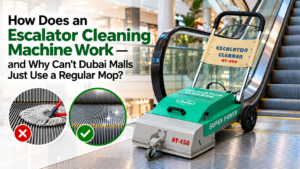
Walk through any major Dubai mall on a Friday evening and you’ll pass the same escalator hundreds of times. What you probably won’t notice is the thin, dark film building up in the grooves of every step — a mix of shoe grit, desert sand, spilled drinks, food oil, and skin cells that compacts into the treads day after day.
That film is the reason escalator cleaning is one of the hardest problems in facility management, and the reason a mop and bucket will never solve it.
Why an Escalator Is Not a Floor
Facility managers often assume escalator cleaning is just floor cleaning at an angle. It isn’t. Three things make escalators fundamentally different:
- The surface is grooved, not flat. Escalator steps are built with deep parallel cleats — those ridges exist for safety, to lock passengers’ feet in place and to mesh with the comb plate at the top and bottom. A mop head glides across the top of those ridges and never reaches the bottom of the groove, which is exactly where dirt collects. You end up polishing the high points while the grime stays untouched below.
- Water is a serious hazard. An escalator is a machine full of electrical components, motors, chains, and a drive system. Flooding it with a wet mop sends water into places it was never designed to go. Excess moisture also creates a slip risk on a moving incline — a far more dangerous situation than a wet flat floor, because a passenger who slips on an escalator falls onto moving steps.
- The surface never stops moving. Cleaning one step at a time by hand means the escalator has to be shut down. In a Dubai mall during trading hours, taking an escalator out of service isn’t a minor inconvenience — it disrupts footfall between floors and directly affects tenant revenue.
How an Escalator Cleaning Machine Actually Works
An escalator cleaning machine solves all three problems at once by working with the escalator’s own movement instead of against it.
Here’s the operating principle:
The machine is positioned at one end of the escalator, typically at the top or bottom landing, and locked in place. It doesn’t travel along the escalator — the escalator brings the steps to it.
The escalator runs at low speed while the machine’s cylindrical or disc brushes engage with the step surface. Because the brush bristles are shaped to penetrate the cleats, they reach down into the grooves where a mop never could, agitating and lifting compacted dirt from the base of each ridge.
Cleaning solution is dispensed in controlled, metered amounts — not poured on. This is the critical difference from wet mopping. The machine applies only as much solution as the brushes need to break down oils and grime, keeping moisture away from the escalator’s mechanical and electrical components.
A vacuum and recovery system immediately extracts the dirty solution as the step passes through, so water is removed within the same cycle it’s applied. The step emerges damp at most, and dries within seconds.
The cycle repeats automatically as the escalator carries every step past the cleaning head, meaning a full escalator — all steps, front and back — is cleaned in a single continuous pass rather than step-by-step by hand.
The result is a mechanical process that cleans down into the grooves, uses a fraction of the water, extracts what it applies, and finishes an entire escalator in a fraction of the time a manual crew would need.
What Makes Dubai a Particularly Demanding Case
Two local factors make escalator cleaning harder in the UAE than in most markets.
Fine desert sand. Airborne silica gets tracked indoors constantly and is small enough to work deep into step cleats, where it acts like an abrasive under foot traffic. Left in place, it doesn’t just look bad — it accelerates wear on the step surface itself. Sand is also precisely the kind of dry, fine particulate that a damp mop smears rather than removes.
Extreme footfall concentration. Dubai’s major retail destinations handle volumes that would be exceptional anywhere in the world, concentrated into evening and weekend peaks. Escalators in these environments accumulate in a day what a smaller facility might accumulate in a week.
Add the region’s high standards for presentation in premium retail and hospitality, and manual cleaning simply cannot keep pace.
The Hidden Costs of Sticking With Mops
Facility managers weighing whether to invest in escalator cleaning equipment usually focus on the machine’s price. The more useful comparison is against what manual cleaning actually costs:
- Labour hours — hand-cleaning an escalator properly takes a crew several hours per unit; a machine completes the same work in a fraction of that time
- Downtime — manual cleaning requires longer shutdowns, often during hours when the escalator is needed
- Incomplete results — the grime stays in the grooves, so the escalator is never genuinely clean, only less visibly dirty
- Accelerated wear — abrasive sand left in the cleats wears the step surface, shortening component life
- Safety and liability exposure — over-wetting an escalator creates slip risk and moisture ingress into electrical systems
Choosing the Right Equipment for Your Facility
Escalator cleaning machines are purpose-built for a single job, which is exactly why they do it well. If your facility has escalators, you can browse our escalator cleaners range to see the specifications and understand what suits your step width and traffic volume.
Escalator cleaning also works best as part of a complete floor care programme rather than in isolation. In most malls, the escalator is cleaned alongside:
- Hard floor scrubbing on the concourse and atrium levels, handled by ride-on scrubber dryers for large open areas or walk-behind scrubber dryers for tighter retail corridors
- Pre-sweeping to remove dry sand and debris before any wet cleaning, using walk-behind sweepers or ride-on industrial sweepers depending on floor area
- Chewing gum removal, a persistent problem around escalator landings and entry points — see our chewing gum removal machines
- Correct cleaning chemistry, since the wrong solution can damage step surfaces or leave residue that attracts more dirt — our cleaning solutions range is matched to commercial equipment
The Bottom Line
A mop was designed for a flat, stationary, water-tolerant surface. An escalator is none of those things. It’s a grooved, moving, electrically powered machine that needs to be cleaned down into its ridges without being soaked — a set of requirements that only purpose-built equipment can meet.
For Dubai’s malls, airports, and transit hubs, escalator cleaning machines aren’t a luxury upgrade. They’re the only method that actually cleans the surface passengers touch, in the time window the facility can afford to give.